Wizards of Oz

"Life is fraughtless ... when you're thoughtless."

20.3.11

Radiation Doses: Fact vs. Fiction

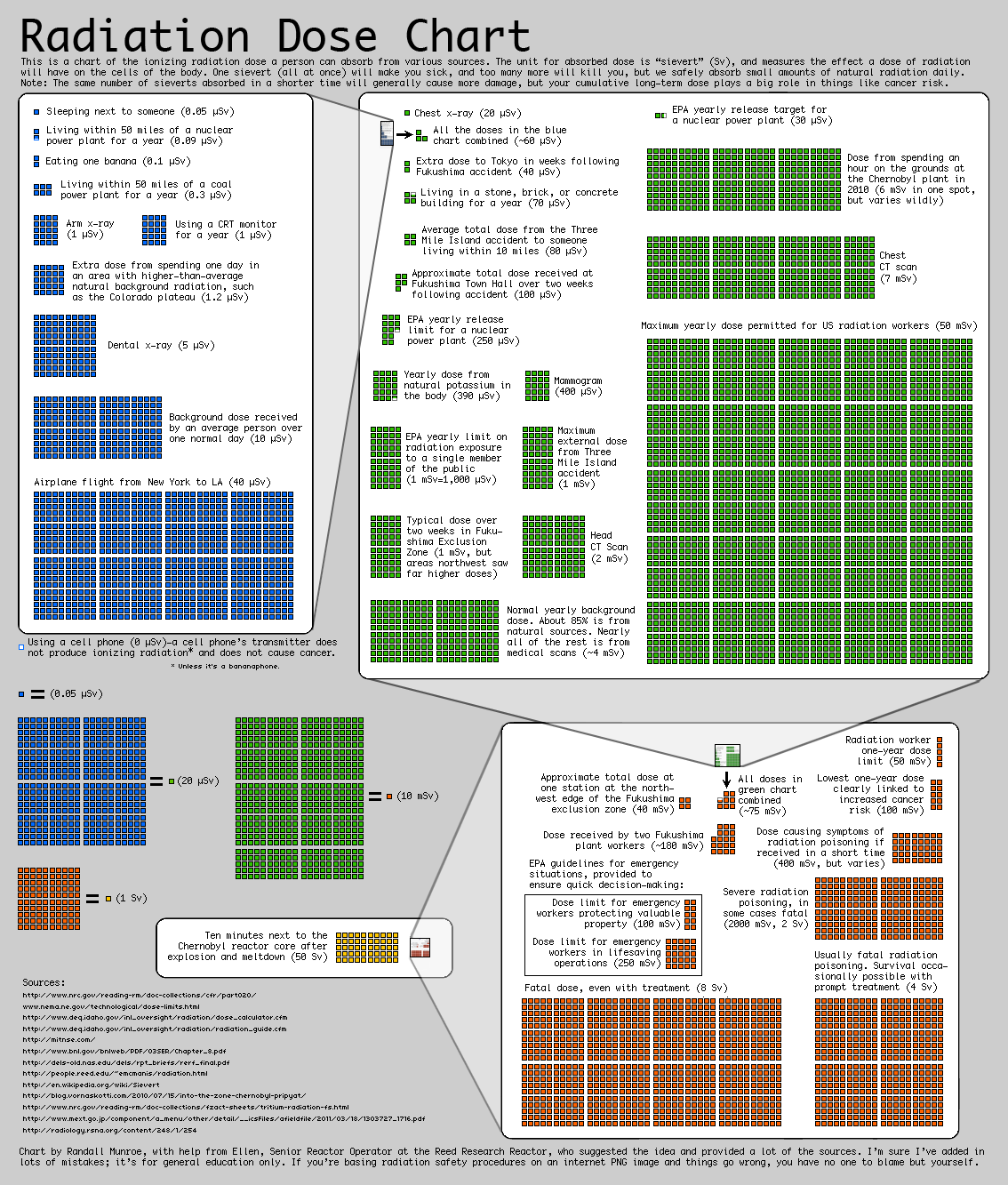
Score another one for the Blogosphere.  Randall Munroe of xkcd.com fame (one of the best comic strips ever for the scientifically inclined) trumps the New York Times with this excellent graphic comparing the levels of radiation we experience in our everyday lives:


Click the link for a full-sized view.

Two things Randall does that make this so compelling are:

1. He includes the temporal factor in his data (something the New York Times failed to do in their overly-hysterical chart declaring that everyone within a half-mile of Fukushima's Daiichi Power Plant is going to die), and ...

2. He shows the scale of routine daily activities (like eating a banana, 1 microsievert or 1 µSv) to medical scans (a mammogram is 3 millisievert, 3mSv) to the minimum one-year dose clearly linked to an increased risk of cancer (100 millisievert, 100 mSv).  Spending an hour on the grounds of the Chernobyl Reactor in Ukraine in 2010 would likely give you a dose of 6 mSv, though it varies wildly; and two sites 50 km NW of Fukushima showed a daily dose of about 3.6 mSv (roughly our annual exposure from natural background radiation) -- but there are many areas closer to Fukushima with no measurable increase.

The bottom line is this: Radiation is a fundamental process in our universe.  It is prevalent in our daily lives, and -- with prudence -- can be used to benefit our lives.  So the next time you hear or read something that sounds alarmist in nature, dig a little deeper.  It may not be as bad as the talking heads would have you believe.

H/T to Charles Cameron at zenpundit.com and Cheryl Rofer at Phronesisaical.

Labels: ,

16.7.10

Day of Trinity

Today is the 65th anniversary of the first man-made nuclear detonation. A prototype of the "Fat Man" Pu-239 implosion-type bomb, fueled by Plutonium enriched at the Hanford site's "B Reactor" in eastern Washington, was detonated in the New Mexico desert near Alamagordo. Hanford, site of today's Pacific Northwest National Lab, is the site of a scaled-up, 250 MWatt breeder reactor based on the Graphic Reactor developed by Enrico Fermi at X-10 (today's Oak Ridge National Lab) in Bethel Valley near Oak Ridge, Tennessee.

This test was the final developmental milestone of the MANHATTAN PROJECT. Exactly three weeks later ENOLA GAY dropped the single "Little Boy" bomb on Hiroshima. 'Single' because the Y-12 site in Bear Creek Valley in Oak Ridge, had produced only enough Highly Enriched Uranium-235 for a single 'gun-type' (vice 'implosion-type') bomb with Cal physics professor E.O. Lawrence's "California University Cyclotrons" (or 'Calutrons').

Three days later, BOCK'S CAR dropped a second "Fat Man" bomb on Nagasaki. Within days Emperor Hirohito capitulated to the unconditional surrender of the Empire of Japan to the Allied Powers - and spared the world the millions of casualties from an invasion of the Japanese home islands.

My grandfather would have undoubtedly been pulled back into the Fleet Marine Force (despite the malaria he contracted on Guadalcanal), and I very likely would not be here today.

So regardless of your thoughts on the 'necessity' of a city attack vice a benign "demonstration" of the capability, it is worthwile to note that the motto of Oak Ridge, Tennessee (where I called home from 2006-2009) is "Born of War, Living for Peace, Growing through Science". And in Oak Ridge's A.K. Bissell Park at the city's center is a friendship bell from the city of Hiroshima.


Labels: , ,

19.5.10

Missile Defense Agency Responds to New York Times Article


From MDA Public Affairs:

The May 18 edition of The New York Times contained an article ("Review Cites Flaws in U.S. Antimissile Program") detailing a study conducted by Dr. Theodore Postol and Dr. George Lewis published in the May issue of Arms Control Today (ACT). The study called into question the test record of the Standard Missile-3 (SM-3) sea-based interceptor that is designed to intercept and destroy short- to medium-range ballistic missiles. The ACT article stated that successful intercepts during tests of the SM-3 actually "missed" targets and should not have been assessed as successful.
The Missile Defense Agency strongly refutes this allegation. The SM-3 program is one of the most successful programs within the Department of Defense, with operational interceptors now deployed aboard U.S. Navy ships. These ships range throughout the world's oceans, providing an effective, reliable defense against short- to medium-range ballistic missiles. An extensive, operationally realistic test program is continuing to further improve and enhance the capabilities of the SM-3 element of the Ballistic Missile Defense System.
For whatever reasons, The New York Times chose not to include information provided to the newspaper by MDA to respond to allegations by Dr. Postol and Dr. Lewis which would have provided accuracy, clarity and context to the article.
Some examples:

"The system is highly fragile and brittle and will intercept warheads only by accident, if ever," said Dr. Postol.

FACT: Not included in the Times article from information provided to the reporter that from 1991 through 2010 the Missile Defense Agency has conducted 66 full scale hit-to-kill lethality sled tests and 138 sub-scale hit-to-kill light gas gun tests covering all MDA interceptor types against nuclear, unitary chemical, chemical submunitions, biological bomblets and high-explosive submunition threats. Eighteen of these tests were specifically devoted to the current SM-3 kinetic warhead system. This extensive database of lethality testing has conclusively demonstrated that MDA's weapon systems are highly lethal against ballistic missile threats when they engage within their accuracy and velocity specifications. After successful completion of early developmental tests, the test program progressed from just "hitting the target" to one of determining lethality and proving the operationally configured Aegis SM-3 Block I and SM-3 Block 1A system. These tests were the MDA's most comprehensive and realistic test series, resulting in the Operational Test and Evaluation Force's October 2008 Evaluation Report stating that Aegis Ballistic Missile Defense Block 04 3.6 System was operationally effective and suitable for transition to the Navy.

"Even so, the Pentagon later admitted that four of the 10 analyzed flight tests carried no mock warheads at all."

FACT: As stated to the Times reporter, three of the four tests cited were the very first intercept tests conducted in 2002 using a prototype SM-3. The objective of these early developmental tests was to determine if an SM-3 interceptor launched from an Aegis ship could hit a ballistic missile in flight. In each test the target was intercepted and destroyed. Since they were the very first intercept tests of the SM-3, specific lethality (hitting the warhead) was not a test objective. Target warheads used in missile defense tests are very complex, expensive assets, and since specific lethality wasn't a test objective, mock warheads were not used in these very early developmental tests. The fourth test cited in the Times article was also not a test of specific lethality. All other SM-3 intercept tests used mock warheads that were threat-representative and extensively instrumented to obtain target data and to determine the extent of their destruction.

"The dispute between the academics and the Pentagon centers on whether it is enough for a speeding interceptor to hit the body of a spent rocket moving through outer space or whether it must hit the attached warhead. Dr. Postol says the SM-3 interceptor must shatter the warhead directly, and public statements of the Pentagon agency seem to suggest that it agrees. 'The interceptors,' the agency Web site says in its basic explanation of antimissile goals, 'ram the warhead at a very high closing speed, destroying the target.' "

FACT: Although MDA provided extensive information, the Times article failed to mention that the assessment by Dr. Postol and Dr. Lewis examined only tests using "unitary" targets, whereby the warhead and booster rocket do not separate, and represents short-range SCUD missile technology. In tests against unitary targets, the SM-3 has been very successful, hitting the target missile at speeds up to 8,000 miles per hour, generating a tremendous amount of energy that caused catastrophic failure of the target missile. The Times article also didn't mention that five of six intercept tests involving separating targets -- when the warhead separates from the booster rocket, and representative of medium-range "No Dong" technology -- were very successful, with the SM-3 directly colliding with the target warhead as it traveled through space, a much smaller and challenging target compared with a unitary target.

"The study examined video images that the SM-3 kill vehicle took a split second before striking the target and that the Missile Defense Agency subsequently made public. The analysis looked at 10 tests between 2002 and 2009 -- all of which the agency hailed as successful intercepts."

FACT: Dr. Postol and Dr. Lewis stated in their article that the video and still images of the intercept were the "final" frame before interceptor impact. This isn't true; they were only images that were publicly released. Although MDA provided this information to the reporter, the Times chose not to report that subsequent sensor views showed exactly where the interceptor collided with the target -- within inches of the planned impact point -- and that these images were not released to preclude potential adversaries from determining the exact impact point.

Labels: ,

29.10.09

Happy 40th, Internet


The Internet is 40 years old today.

The very first host-to-host packet-switched message ever sent over the fledgling "ARPANET", an information network developed by BBN Technologies under a contract awarded by the Pentagon's "Advanced Research Projects Agency" (today known as DARPA), was sent 40 years ago today.

At 10:30pm PDT on October 29th, 1969, a UCLA student using an SDS "Sigma 7" host computer sent the word "login" to an SDS 940 interface message processor (IMP) 300 miles north at the Stanfurd Research Institute. Though the system crashed after only the first two letters were transmitted ("lo"), the remote IMP login was accomplished an hour later.

The original 1822 protocol, which was designed for reliability and assurance (i.e., the host would be able to tell if a message was lost), was later replaced with the Network Control Program (NCP) that allowed simultaneous message sharing between different hosts. The modern Transfer Control Protocol / Internet Protocol (TCP/IP) was adopted by ARPANET in 1983.

ARPA, the world's 200 million plus blogs thank you.

Labels: , ,

20.7.09

Moon + 40

40 years ago today, I was a toddler living in southwest Michigan with a second birthday coming up. My first recollection of our nation's space program was watching the APOLLO-SOYUZ linkup as an almost-seven-year-old waiting in a hospital lobby in Jacksonville, Florida for my 2nd major ear surgery.

The APOLLO 11 landing was the culmination of an ambitious vision laid out by President Kennedy some seven years prior -- a speech asking imponderable questions like "Why climb the highest mountain?" and "Why does Rice play Texas?"

While Neil Armstrong and Buzz Aldrin deserve all of the accolades of being the first humans to walk on another celestial body, my personal hero is Michael Collins: the pilot of the Command Module COLUMBIA and designer of the mission patch who could only watch from above as his two colleagues' names became forever etched in the nation's memory.

And why was he stuck in the Command Module? One reason: to perform unscheduled maintenance. That, and his personal disdain for geology.

Congratulations to the entire crew of APOLLO 11 for inspiring our world, and making the Universe seem just a little bit smaller!

Labels: , ,

21.3.09

60 Years Ago: Secret No More

The city of Oak Ridge, founded solely as the site for enriching the fuel of the world's first nuclear weapons during the Manhattan Project of World War II, was a cloistered community where residents had to wear identification badges outside of their homes and visitors needed security clearances.

All of that changed sixty years ago, on March 19th 1949, when the "Secret City" of Oak Ridge was opened to the world at a "ribbon burning" hosted by Vice President of the United States Alben Barkley. Today's commemoration featured the contemporary peers of the dignitaries from that day (with the exception of VPOTUS): Gerald Boyd, Manager of the Dept. of Energy's Oak Ridge Office, for John Franklin, the 1949 Manager of the U.S. Atomic Energy Commission's Oak Ridge Operations; Dr. Thom Mason, Director of ORNL, for C. Nelson Rucker, the 1949 Director of X-10; Mayor Tom Beehan, for 1949 Town Council Chair W.A. Swanson; and Rev. Mark Walton, 2009 Pastor of Glenwood Baptist Church, who delivered the same invocation as Rev. Roy Arbuckle, the 1949 Pastor of Glenwood Baptist Church.


In the 1949 "ribbon burning", following remarks by Fred Ford (the 1949 U.S. Atomic Energy Commission Director of Community Affairs), George Felbeck (who led the K-25 gaseous diffusion purification plant for Carbide) made a 13-word telephone call to the operators at the Graphite Reactor in X-10 (ten miles away in Bethel Valley, today's Oak Ridge National Lab) to initiate the energy pulse that would burn the ribbon and officially open the Secret City to the world. While the 10,000 onlookers on that day had to wait nearly three minutes for the capacitors to charge and the ribbon to burn, today (after city historian Bill Wilcox's identical call), we only had to wait about 40 seconds:


Labels: , ,

20.3.09

AMSE and Neighbors

Today I took the older kids (two plus visiting friend Jake, who was Shelby's Baby Hui pal way back when in the 1990s) to the American Museum of Science and Energy in Oak Ridge. AMSE is the best museum deal we've found, with a family membership for only $35 and several pages of reciprocal museum listings worldwide.

This week is the 60th anniversary of both the founding of AMSE as well as the "opening" of Oak Ridge, so admission was just a quarter (yep, $0.25) per person.

Jake showed how to levitate (with the help of a floor-to-ceiling mirror), while (below) Shelby tried the Van der Graaf generator and Jarrett worked in the Y-12 style glove box.


After a quick stop at the Razzleberry Ice Cream Lab, we walked down the hill for a "farewell party". Dozens of neighbors and friends came to wish us safe travels -- a bittersweet evening!

Labels: , ,

11.3.09

Civilian Control of Nuclear Weapons

Oak Ridge National Laboratory's "History Room" is a veritable treasure trove of insights into the early days of the Cold War and the transition from the Manhattan Project to a civilian-led Atomic Energy Commission. Since 60% of the entire Manhattan Project budget was spent here in east Tennessee, it's a fitting and appropriate role for the lab (formerly known as "X-10") to play.

Last year a retired lab chemist named Ellison Taylor passed away at the age of 94. The executors of his estate provided the History Room with a box of his personal papers. Buried within his research notes was a carbon copy of a letter dated 18 March 1946, signed by fifteen Division-level managers from X-10 (including future Laboratory Director Alvin Weinberg, who would later chair a commission for President Kennedy that sowed the seeds for increased transparency in government).

This letter was addressed to Sen. Brian McMahon, Chair of the Senate Special Committee on Atomic Energy and author of the forthcoming Atomic Energy Act of 1946. At issue was the manner by which nuclear weapons research would be managed within the federal government.

On the one hand, MG Leslie Groves deftly left the Manhattan Project to a swift and favorable conclusion of World War II. The "establishment" logic, embodied in the Vandenberg Amendment to the proposed Atomic Energy Act, which would have created a governing military board with "veto" authority over the proceedings of the Atomic Energy Commission.

The scientists had work
ed side-by-side with soldiers for more than four years. Their opinion was that "... that military control would ... increase immeasurably the very dangers that we wish to avoid."

This paragraph summarizes the civilian scientists' sentiment for "The Army Way":
The delays produced by the army system of compartmentalization, denying the research men on the atomic energy project access to facts that are necessary for their work, the procrastination in releasing results of highest value to the medical and biological sciences though these results are of no military importance, show that it is only detrimental to place the power of censorship into the hands of persons who are in no position to judge the facts.
The Atomic Energy Act of 1946 was passed -- without the Vandenberg Amendment. And civilian control of our nuclear arsenal, a model complementary to our nation's civilian control of its military forces, was assured.


Labels: , ,

19.9.08

"Secret City's" 66th Year


Today (Friday, September 19th) marks the 66th anniversary of the formal designation of East Fork Valley in east Tennessee as the site of the "Secret City". It was on this day in 1942 that Major General Leslie Groves, U.S. Army (and Director of the Manhattan Project) stood atop Elsa's Ridge on the east edge of East Fork Valley, near a sweeping bend of the Clinch River, and declared that this valley would become home to the city that would house the bulk of the Manhattan Project.

During World War II, the project was known as the "Clinton Engineering Works" -- and housed at its peak more than 75,000 workers and their families. The Uranium-235 that powered the LITTLE BOY bomb on August 6th, 1945 came entirely from the Y-12 site in Bear Creek Valley (just across Pine Ridge to the south), while the crown jewel of Dept. of Energy National Labs lies one more valley to the south (Bethel Valley, across Chestnut Ridge from Y-12). And at the extreme west end of town, between East Fork Ridge and Blackoak Ridge, the K-25 site was a cornerstone of our nation's nuclear deterrent until its shutdown in the mid-1980s.

Happy Birthday, Oak Ridge!

Labels: ,

11.9.08

LHC: Game On!

The most powerful particle accelerator in the world, CERN's Large Hadron Collider, was turned on yesterday. And we're still around to talk about it! (So no, the fabric of the spacetime continuum was not breeched by the power of the beam -- though the marketing spin citing the 'power of the Big Bang' is a bit over the top...)

Hadrons are particles comprised of bound quarks, such as the protons and neutrons that make up all of the elements on the Periodic Table (as compared to "leptons", or "light particles", with no quarks -- such as electrons). At full power, this 27-km diameter synchrotron will accelerate protons in opposite directions to 99.9% the speed of light -- then shunt them into a collision chamber to see the results. Some are expecting to see the "Higg's Boson", the last of the "Standard Model's" predicted particles yet to be observed. The Higg's Boson would help explain why some massless particles (like photons) can cause other particles to have mass -- which can in turn help us understand "mass" far beyond Einstein's famous relativistic formula "E=mc^2".

I strongly recommend you check out Jorge Cham's brilliant comic strip "Piled Higher and Deeper", in particular his most recent three strips describing his "Tales from the Road":

Tales from the Road: CERN Pt 1
Tales from the Road: CERN Pt 2
Tales from the Road: CERN Pt 3

Stay tuned to this journey of discovery into the very essence of matter!


UPDATE: For an even more humorous spin (pun intended :-), check out Randall Munroe's strip "xkcd" from yesterday on the same topic. Bonus points for those who can find the six quark names hidden in the strip!

Labels: ,

28.8.08

Sensor Fusion in Baton Rouge


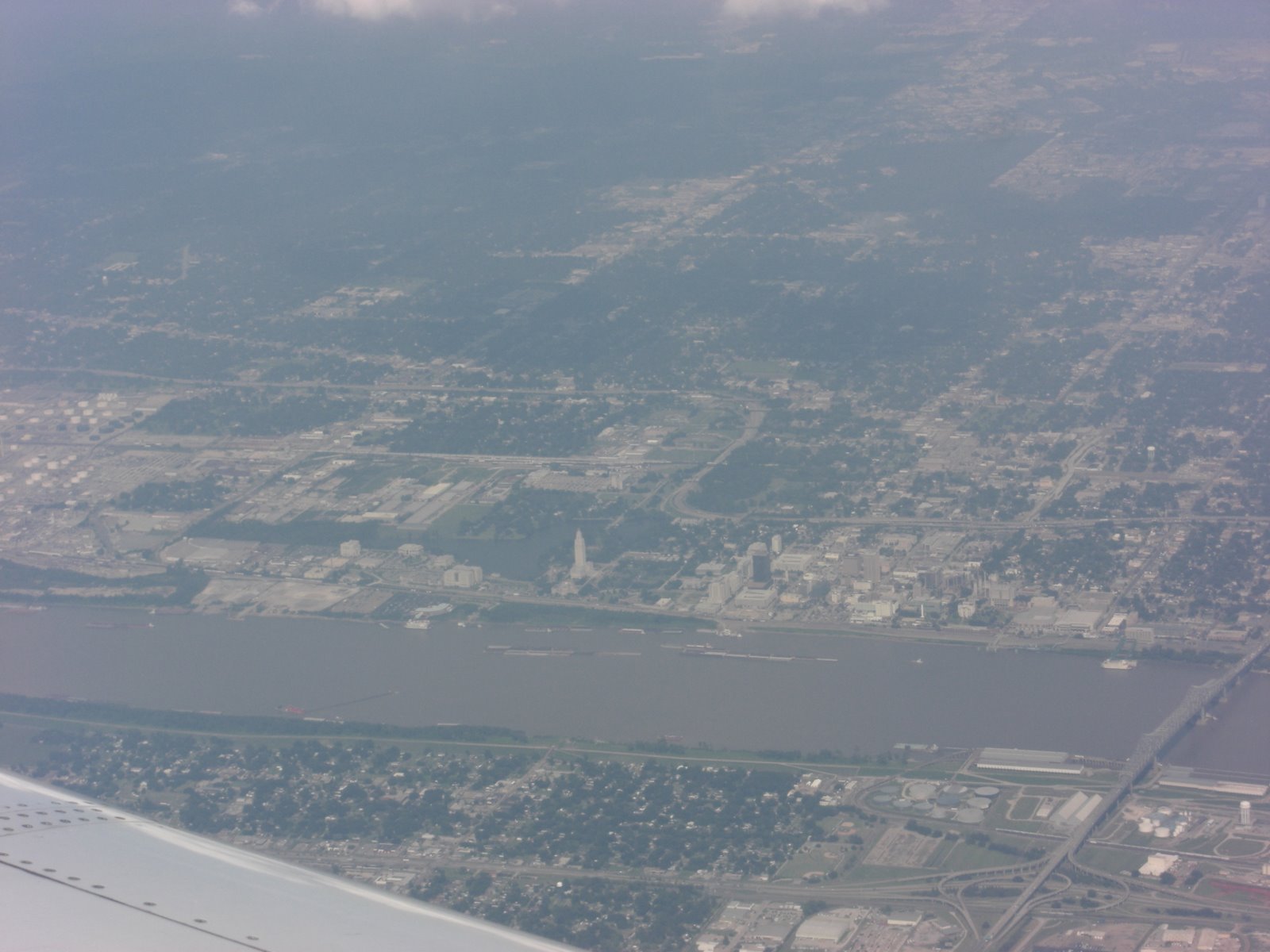
The Melton Valley-SensorNet project has come to Baton Rouge, Louisiana - home to the greatest concentration of chemical refineries, barge traffic and storage facilities in the United States. We showcased our project in conjunction with the Baton Rouge Area Mutual Aid System (BRAMAS) conference to the HazMat chief from Baton Rouge Fire Department, as well as representatives from Army Research Office's Chemical Sciences Division, regional FBI and other first-responder representatives.


Oak Ridge National Lab has developed an ingenious sensor mash-up that integrates real-time sensor data with response plans/policies, meteorological data, and predictive models in order to inform First Responders and other decision makers. The sensor package shown above is a chemical sensor developed by SeaCoast Science, Inc. of Carlsbad, Calif.


In this video, Magnus Oding of Scan Pacific Northwest, LLC of Mukilteo, Wash. launches the sensor via a pneumatic line thrower along the levee in downtown Baton Rouge. These sensors, when integrated with the communications architecture developed by Oak Ridge National Lab (that correlates space-time information with real-time sensor readings and predictive dispersion models), will provide enhanced situational awareness to any decision maker who has to make high-consequence, time-sensitive decisions to protect people and property.


Web 2.0 capabilities merged with sensing capabilities and predictive models create a next-generation "toolbox" for emergency management and disaster response.

Labels: , , , , ,

18.8.08

New Oak Ridge High School


Five years of community planning and fundraising, eighteen months of construction, over $60 million dollars and the newly renovated Oak Ridge High School is open for business.

I have never seen a community come together in such a moving and powerful fashion as Oak Ridge. With the leadership of UT-Battelle (manager of Oak Ridge National Lab) and their $2 million donation, the Oak Ridge Public Schools Education Foundation (of which I am honored
to be a part) and the community (through donations, sales tax increases & QZAB bonds), this school of 1,400 is now home to:

  • A science curriculum second to none
  • Five Career Academies integrating communications, math & science
  • A Center for the Arts
  • Technology labs for every department
  • State-of-the-art instructional facilities and libraries


In a very moving dedication ceremony, Principal Chuck Carringer "presented" the school to a panel of students drawn from across all Oak Ridge schools -- one student from each grade, pre-K through 12th grade:


This is a great day for Oak Ridge, and for excellence in science education among any school - public or private. And it is our biggest regret in our upcoming move to Colorado: that my kids will not get to be students in this extraordinary place.


(Donor Wall with Astrolabe)


Labels: , ,

26.7.08

Guest Post @ MountainRunner

Matt Armstrong, Sage of Public Diplomacy and administrator of the popular 'blog MountainRunner, has indulged me with a guest post. Check it out.

Labels: , ,

20.5.08

Climate Change: Reprise

Back in September I wrote a post entitled "Climate Change: Yes, But Why?". My premise was that, while "climate change" is clearly occurring, the issue of causality needs more attention.

After that post, I asked some members of the Oak Ridge National Lab staff (including one of ORNL's corporate fellows, Dr. Tom Wilbanks, who was part of the Nobel-winning Intergovernmental Panel on Climate Change) to share their perspectives. Tom was able to point me in the right direction regarding infrared absorption of various molecules (e.g., H2O, CO2, etc.).

This month's WIRED (16.06) has a great point-counterpoint cover story (which, in the URL, is referenced as "heresies"). Among their proposed "heresies" are Embrace Nuclear Power, Carbon Trading Doesn't Work and China Is The Solution. I think these are great points -- points that hopefully will shift the dialog from impassioned proselytizing to rational decisionmaking. (However, a cursory glance at the WIRED comments section shows this to be a vain hope....)

The WIRED piece has motivated me to renew my own research into the causal relationships between solar radiation (which has been on a cyclical increase, with a corresponding decrease in sunspot number), natural phenomena, and human influence. I finally found a graphic that I find compelling:

This graphic (h/t Thomas Everth's GreenBlog in New Zealand) shows total atmospheric absorption of various frequencies of electromagnetic radiation, as well as individual absorption spectra for ozone (O3), water (H2O) and carbon dioxide (CO2).

It also overlays the distribution of incident solar radiation (most of which is between 200nm and 2μm wavelength, covering the visual spectrum of light as well as the near-infrared band) as well as the Earth's outgoing thermal radiation (covering the infrared-C band from 3 to 80 μm wavelength). Note that the x-axis (wavelength) is a logarithmic scale, going from 0.1 to 1, 10 then 100.

The red line shows the absorption of O2 + O3 (ozone). As expected, the left side of ozone's absorption spectra (wavelength below 200nm, in the ultraviolet spectrum) shows nearly 100% absorption. Our natural defense against harmful ultraviolet radiation is the ozone layer (which is depleted by chlorofluorocarbons, but that's for another post).

The blue line shows the absorption spectrum of water. While some have claimed that water vapor is the real culprit behind global warming (usually with some reference to how much warmer we are when there's a cloud layer), this plot shows that water's absorption spectra drops where the outgoing thermal radiation increases. Therefore, water is nearly transparent to the infrared-C radiation between 5 and 20 μm wavelength. This too is expected -- otherwise Forward Looking Infrared (FLIR) wouldn't work on humid nights or with a high water vapor content in the air.

What I find compelling is the green line showing CO2's absorptive properties. In particular, note the spike in absorption between 10 and 20 μm -- where CO2 absorbs nearly 100% of incident IR-C radiation.

When I first considered the absorption and scattering of radiation by molecules in our atmosphere, I initially discarded it as a cause for concern. My rationale was that the absorbed radiation would be randomly scattered, or re-radiated -- and therefore would balance itself out.

While this is true for incoming radiation from external sources (e.g., the sun), what I failed to consider is that we live exothermic lives on Earth. When we convert fuels into energy, we're also creating heat -- so the outbound radiation becomes the key consideration.

By adding the outbound radiation to the equation, with nearly half of the absorbed radiation being scattered back to the Earth, we can conclude that carbon dioxide is a major contributor to climate change.

What can we do about this? Invest in alternative, renewable energy sources (such as solar, which is getting more efficient in capturing the 1.3kW per square meter peak incidence from the sun; wind, with some models generating more than 6MW per turbine; and better batteries to store energy). Travel less (thanks, Internet). And save.

Labels:

25.4.08

Chernobyl + 22

22 years ago, on a late April evening near the city of Pripyat in northern Ukraine, Reactor #4 at the V.I. Lenin Memorial Chernobyl Nuclear Power Station exploded. This disaster, the only instance to date of a "Level 7" on the International Nuclear Event Scale, resulted in a complete breach of the containment dome accompanied by a severe nuclear meltdown. (By comparison, the Three Mile Island accident in Pennsylvania was a Level 5: "Accident with Off-Site Risk".)

The four reactors at Chernobyl were each GigaWatt-output "reaktor bolshoy moshchnosti kanalniy" (Reactor-High Power-Channel Type, or RBMK). Together, these four reactors provided 10% of Ukraine's electricity.

RBMK reactors rely on light water (i.e., non-deuterium or tritium hydrogen in the water) for cooling, and graphite rods for moderation (akin to the world's first-ever nuclear reactor, the Graphite Reactor in Oak Ridge, Tennessee). Given the size of RBMK reactors and the methods for moderating fast neutrons, they can use natural uranium (vice enriched) for fuel. This also makes the design prone to instability, where boiling coolant can create a very large void coefficient: coolant that is supposed to act as a neutron absorber is boiled away, which increases the reactivity of the core, creating more energy in a positive feedback loop. The added energy can quickly lead to a "Loss of Coolant Accident", which in a large system like the RBMK leads to a catastrophic failure. (BTW: The word "scram" -- which Webster's defines as "a rapid emergency shutdown of a nuclear reactor" -- is actually an acronym coined by legendary physicist Enrico Fermi.)

In late April 1986, while Chernobyl's Reactor #4 was shut down for maintenance, technicians decided to test the ability of the reactor's turbine to power the safety systems should external electrical power be lost. The key question was whether or not the turbines, as they wound down from the reactor, could power the reactor's water pumps while the backup diesel generators came online. Though earlier tests had failed, the technicians wanted to check if recent modifications were sufficient to achieve positive results.

Before the reactor power had been decreased for the test to be conducted, a regional power station went off-line. The grid controller from the Ukrainian capital of Kiev asked that further power reductions from the reactor be postponed to allow sufficient electricity to meet evening demands.

But the night shift was not informed of the postponement. So, when the Kiev grid controller allowed the reactor shut-down to continue, the technicians at Chernobyl instead followed the original test protocol and powered down too quickly. This led to a build-up of Xenon-135 -- a highly-effective neutron absorber that can "poison" a reactor.

Technicians who began to increase the reactor power for the test saw far less power than expected. Unaware of the Xe-135 build-up (and commensurate "burn-off" as neutron flux increased), they removed the graphite rods to increase the reactivity. The increased power and decreased moderation from the graphite rods created steam bubbles in the coolant -- increasing the void coefficient described above. And though the technicians began to "scram" the reactor at 01:23:40 local time, the spike in energy caused the control rods to fracture and jam.

At 01:23:47 local time, as the last of the Xe-135 was burned off, the reactor jumped to 30 GigaWatts thermal: more than twenty times normal operating output. The fuel rods began to melt and the build-up of steam pressure created an explosion that blew off the reactor lid, resulting in a surge of oxygen that caused the graphite to ignite. The loss of containment and the graphite fire exacerbated the spread of radioactive debris throughout the region.

Today, Pripyat and the surrounding area (within a 30km radius of the reactor) is abandoned. Chernobyl has been shut down. However, there are still several RBMK reactors in operation in the Former Soviet Union (in St. Petersburg, Kursk and Smolensk).

Having spent this week at a 5-day "Team Leader Training Course" for the TapRooT Root Cause Analysis methodology, I have a new appreciation for the consequences of "human performance difficulties", particularly with highly complex systems. (Maybe Vinay Gupta and John Robb have a point re: "Resilient Communities" and "simple solar"!)

Labels: ,

9.4.08

REVIEW: Taleb's "Black Swan"

After resting comfortably in my "anti-library" for many weeks, I recently plucked The Black Swan by Nassim Nicholas Taleb from my dusty nightstand. Since I was embarking on cross-continental flights (albeit with kids), I was looking forward to punctuating the drink-and-peanut monotony of Southwest Airlines (an airline woefully unequipped for flights longer than 90 minutes) with Taleb's insights.

Since my days as a civilian employee of the U.S. Navy, where I evolved from an aspiring systems engineer to a "Science Advisor" to a manager leading the "Red Team" at U.S. Joint Forces Command J9, I have been fascinated with the prospect of "adversarial surprise". Like most analytical efforts under the loose employ of the Pentagon (which has roughly one government civilian employee [tail] for every two active duty soldiers/sailors/airmen/Marines [tooth]), this was a cottage industry.

Taleb's insights echo many of our observations in the Joint Experimentation program, particularly regarding the hubris of intellectualism. His skepticism of inductive logic, his emphasis on the importance of context in perceiving information, and his lionization of Doktor Prof. Sir Karl Raimund Popper (whom I had the pleasure of driving from leland stanfurd junior u. to Cal some 20 years ago in my Nissan Sentra) as well as Henri Poincaré are worthy of note.

However, his self-referential anecdotes are reminiscent of a Tolstoy novel, and his clear disdain for planning (née prediction) creates a scotoma that pulls him into the same abyss of solipsism that consumed David Hume.

The depth of his criticisms can be summarized quite succinctly as:
Don't use quantitative methods for qualitative questions.
Nature is benign, so we can ascribe a comfortable level of determinism to our observations. New data, often obtained through technological innovation, requires modification of obsolete theories (e.g., the Ptolemaic model of the universe to the Copernican; Newton's Laws of Motion to Einstein's Special Relativity; etc.). Key to our understanding (though Taleb would probably insist we understand nothing) is the selection of appropriate parameters -- and to not get too enamored with your own theories, especially if it involves any vestige of "free will".

Fallible? You betcha! Yes, we are inclined to fool ourselves. Yes, we try to cram too many variables into our formulae in some vain hope that we'll "get it right". And yes, our institutions -- particularly financial ones -- tend to reward the wrong kinds of behavior (q.v. Prof. Clay Christensen's The Innovator's Dilemma, in which Clay digs into corporate failures vice successes, finding that Wall Street rewards bad behavior). But Taleb's diatribe against the folly of "epistemic arrogance" has created another confirmation bias that only casually addresses the issue of scale when considering complex topics.

I understand that I am straying far from the "anchor" of many blogfriends (John Robb, Art Hutchinson, General of the Hordes Subadei, ARHerring, zenpundit, Chet Richards) who have offered glowing praise for The Black Swan. Perhaps it's my naïveté (or perhaps that I'm a product of the California public school system), but I honestly don't see our civilization marching toward "Extremistan". Quite the opposite: While our awareness of remote events has increased, and our networks have grown exponentially, I believe that the diffuse topology of our networks actually dampens the impact of an extreme event.

Consider the "Butterfly Effect". Do you really think a butterfly flapping its wings in Jakarta is going to eventually cause a hurricane in New York City? Or do you think the minor perturbation is absorbed locally without cascading into some kind of resonance? Yes, there are examples that illustrate the dire consequences of unplanned resonance. Taleb (who waffles at the end of his book as half hyperskeptic, half intransigently certain) abandons the Gaussian bell curve, yet -- with only a single mention of Albert-László Barabási -- firmly embraces Power Law scale invariance as normative.

Despite Taleb's too-casual treatment of scale, I think he would agree with George E.P. Box's statement (c. 1987) that "...[A]ll models are wrong, but some are useful." Abandoning our dogmatic devotion to certainty is essential in any creative, innovative enterprise -- and can reveal hidden opportunities, and hidden abilities.

This requires that we reexamine how we define "success". In my adopted hometown of Oak Ridge, Tennessee, the best Calutron operators (the electromagnets that separated Uranium isotopes for the LITTLE BOY bomb at Y-12 during the Manhattan Project) were not the scientists from Berkeley who designed them, but seamstresses with no scientific training. And how many Americans would consider Tommy Franks or Norman Schwarzkopf as the most successful U.S. commanders in the Mid-East? What about Tony Zinni (who didn't win a major theater war, but may have demonstrated even greater skill by avoiding one)?

While many of us point to 9/11 as a "Black Swan", I can say unequivocally that it had a far less dramatic effect on my life than Continental Flight 196 on March 6th, 1993. Could I have predicted when or how I would meet the woman that would be the mother of my children? Of course not.... But was I open to the possibility, and adaptive enough (when jabbed in the ribs by Helen from Purchasing to move up one row on that flight) to take advantage of this blessing?

That may be the best value of Taleb's Black Swan: to jar us out of our collective comfort zones, to remind us how ignorant we truly are, and to encourage us to "Be Prepared!" Good advice, regardless of whether you live in Mediocristan or Extremistan.

____
Update: Überblogger Zenpundit has graciously linked this review -- and will have his own review posted this weekend. (Thx Zen!)

Labels: , , , , , , , , ,

7.4.08

Scale and (Over)Simplification

Following up yesterday's post on "Complexity and Scale", and the alarmist notion that society is bound to collapse because of its increasing complexity, let me turn the tables and describe a worrisome trend: that of oversimplification in the face of complexity.

Prof. Yaneer Bar-Yam of the New England Complex Systems Insitute (NECSI) has done pioneering research into the dynamics of complex systems. The first textbook on the subject was written by Yaneer in 1997, and a more-accessible (i.e., less math) introduction on applying complexity science to real-world problems (Making Things Work) followed in 2004. One of the most fundamental concepts in complex systems is the trade-off between complexity and simplicity when related to scale. Greater complexity at a large scale means greater simplicity at a fine scale, and vice versa.

Where we get into trouble is when we ascribe simple models that are inadequate for the complexity at a given scale. For instance, a hierarchy is limited in its inherent complexity to the complexity of its leader. Yet we persist in building simple hierarchical organizations (e.g., CPA and its successor organizations in Iraq) when the dynamics of the environment call for a more modular, diffuse network of organizations. Ashby's Law of Requisite Variety (c. 1956) asserts that, for a system to achieve stability in the midst of perturbations, its number of control variables must be greater than the number of possible states in that system.

Therefore, the most efficient organization in a dynamic, complex large-scale environment is not a Napoleonic hierarchy with a single overarching authority -- but rather a distributed, loosely connected network of specialized subnets that are empowered to act in response to system perturbations. Pop quiz: does the latter statement better describe the organizational paradigm of the coalition forces in Iraq, or of the various other force structures there (Mahdi, Badr, AQI, etc.)?

It is interesting to note that General Odom's recent Senate testimony (h/t Abu Muqawama) associates the decline in violence since General Petraeus's " ... reflects a dispersion of power to dozens of local strong men who distrust the government and occasionally fight among themselves. Thus the basic military situation is far worse because of the proliferation of armed groups under local military chiefs who follow a proliferating number of political bosses." Increased complexity at a higher scale due to the diffusion of military authority to lower scales.

The implications for the conventional force structure of the U.S. security infrastructure are profound. To borrow terminology from Tom Barnett, not only does this mean "Leviathan" can't do "SysAdmin" -- it means that the idea of a centrally-organized SysAdmin is doomed to failure.

Now that the study of self-organized criticality is 20 years old, which describes when a critical point in a dynamic system acts as an attractor, perhaps we will see commensurate change within our organizational models. For instance, the "Incident Command System" of the Federal Emergency Management Agency (which was derived from interagency evolution in response to wildfires, which was in turn derived from the military's deliberate planning process) defines standards to facilitate rapid organization, information sharing and decision-making.

Organizational models that facilitate effective (and appropriate) exchange of information, and -- most importantly -- allow the organization's evolution in the face of cooperation and competition are more effective in contending with the complexity of our world.

Labels: , , ,

6.4.08

Complexity and Scale

A post on KurzweilAI.net last week caught my eye. It excerpted a recent article in NewScientist entitled "Why the demise of civilisation may be inevitable", which declares that society's increasing complexity also increases its fragility -- and the energy needed to sustain it. What the gang at KurzweilAI.net missed is the nature of scale in complex systems dynamics.

In fact, this is the second time in a month that KurzweilAI.net has come up short. The other time was a report on a pandemic influenza detecting chip -- conveniently appearing just prior to a Pandemic Influenza Tabletop Exercise I recently participated in. But their report was wrong about current capabilities: first responders can identify various strains via an emergency polymerase chain reaction (PCR) test in 2-3 hours, not "days or weeks" as reported on their 'blog.

KurzweilAI's alarmist reporting on social complexity -- and the concomitant "solution" of "reducing" society's complexity by reengineering our institutions at a smaller scale -- shows scant attention to the essential role scale plays in complexity. To wit, if a phenomenon appears random or unpredictable at a fine scale (e.g., turbulent flow), it can be predicted at a large scale. Conversely, phenomena that are unpredictable at a large scale (e.g., ethnic violence) can be predicted at a fine scale. [The link is to the Ethnic Violence page at the New England Complex Systems Institute, and to a paper published in the journal Science last September presenting their models. These models showed a 90% correlation between single-parameter predictions (after wavelet filtering) and reported incidents in Bosnia-Herzegovina, and even higher correlations in India.]

The underlying assumption of KurzweilAI (and Ms. MacKenzie at NewScientist) is that complexity is directly proportional to scale: the larger the scale, the greater the complexity. Similarly, the smaller the scale, the less the complexity.

However, when you decouple scale from complexity, you begin to see a better fit with our observed reality. Conventional military operations (à la Schlieffen Plan, the Fulda Gap, and OPLAN 1002, to name a few) entail massive amalgamations of forces for the express purpose of simplifying the commander's perspective. Rather than drowning in the minutiae of individual soldier movements (or even platoon or company-level engagements), theater commanders -- with the helpful MIL-STD-2525 symbology, similar to NATO APP-6A -- are able to think in terms of Corps and Division elements (and, lately, Brigades -- the primary warfighting organizational element of the U.S. Army). Therefore, large scale -- but low aggregate complexity.

When the battlefield loses its conformity, though, the scale decreases -- while the complexity increases! Consider which of these two scenarios are more "complex":

1) U.S. Army V Corps blocking the Soviet 8th Guards Army in the Fulda Gap, or ...
2) U.S. Army V Corps serving under the Coalition Ground Forces Commander in post-OIF Iraq.

Many have described the inherent complexity of loosely-coordinated small forces combating a monolithic adversary, most notably the contributors to the Small Wars Journal, John Robb, and the gang at Defense & the National Interest. Perhaps the Kurzweil crew would benefit from paying more attention to these "ideas at the intersection".

Labels: , ,

30.3.08

San Francisco Travelog

We're spending the weekend in the San Francisco Bay Area. Posterity of Oz (who too-quickly adapted to Pacific Daylight Time, which will make returning to school on Tuesday morning quite problematic) enjoyed visiting the Aquarium of the Bay at Pier 39. The photo above is in one of the "tubes" beneath a school of anchovies, and at right they are petting a skate.

We also paid a visit to the USS HORNET (CV-12) Museum at Alameda Point (the former Naval Air Station), but were deterred by their preparations for a conference of more than 3,000 machinists in the hangar deck. On our way off post, we saw the French maxi-catamaran GITANA 13 -- the sailboat that is shattering records around the globe. The crew of 11 had just set a new record for the Route de l'Or (New York to San Francisco via Cape Horn), breaking the old record by more than 14 days. (Yes, *days*.) They should embark for Japan later this week, where they hope to add the trans-Pacific sailing record to their growing list of accolades.

No visit to the Bay Area is complete without a stop by the alma mater -- and, this time, a trek up Strawberry Canyon to the Lawrence Hall of Science. Their special exhibit this month is "SPEED", with throttle-driven drag racers that risk stalling due to slipping wheels, a side-by-side ski slalom simulator, and a build-it-yourself Lego derby track.

But the main purpose of this weekend was to honor (and thoroughly roast) my mom, who retired last Friday after more than 32 years of service to the Alameda County Health Services Agency. More than 140 colleagues, friends and family came to honor her, while I had the privilege of co-MC'ing -- and laying the blame for the soon-to-be-bankrupt Social Security Trust Fund squarely on her shoulders for leaving the workforce. Truly an enjoyable trip.


Labels: , , ,

19.3.08

Arthur C. Clarke (1917-2008)

Science fiction author, pundit, pioneer and visionary Sir Arthur C. Clarke passed away this morning in his adopted home of Sri Lanka. His short story The Sentinel (1948), which inspired his 1968 novel (and later one of my all-time favorite films) 2001: A Space Odyssey, demonstrated his keen insight into the perils of "artificial intelligence" and technological advancement.

Most notable was Clarke's professed skepticism of humanity and our inclination for self-destruction. A persistent theme in his Odyssey series (both the Space Odyssey as well as his later Time Odyssey trilogy) was the essential role "godlike" aliens played in creating -- and regulating -- sentient life in the Universe. His application of the Second Law of Thermodynamics (that entropy increases over time) and the implicit justification of his aliens' "regulation of life" to postpone the ultimate heat death of the Universe is a compelling syllogism.

Sir Arthur's creativity gave us a glimpse into our own souls, and the cosmic implications of our folly. For that we owe him our gratitude, and our well wishes as he today embarks on his own Rendezvous with Rama.


Update: Other tributes from Sharon @ Danger Room, Kingdaddy, Jason S., Jay M., Soob and Cheryl R.

Labels: , , , ,